With May finally here and the season shifting, I’ve been thinking a lot about what it actually means to rest — not as a reward for productivity, but as a practice in itself. That thinking led me back to a concept I’d been researching all spring. It felt like the right moment to share it.
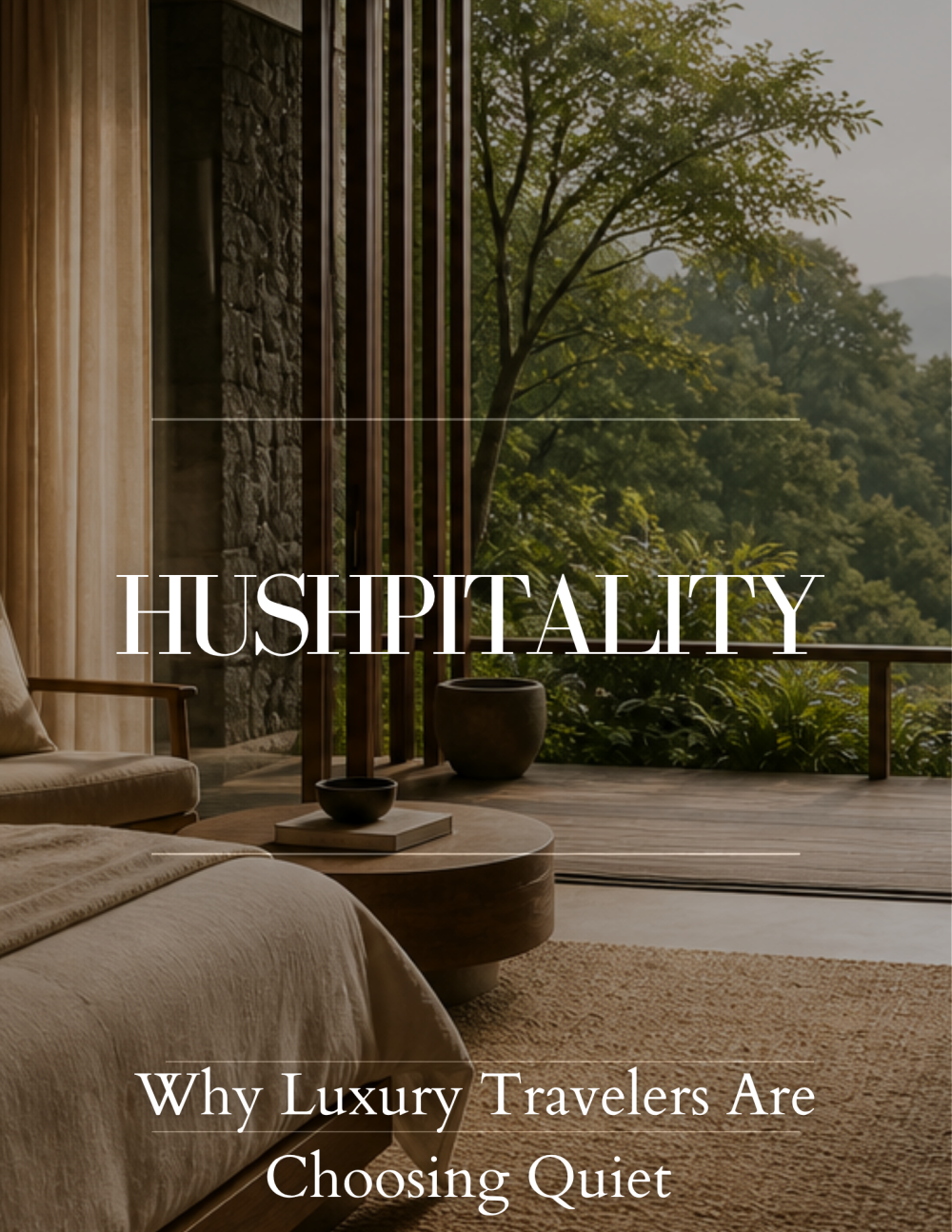
There is a particular quality of quiet that only certain spaces possess. Not the absence of sound exactly — but a deliberate, designed calm that you feel in the body before you can articulate it. The kind you encounter in a room where the acoustics have been considered, where the walls absorb rather than reflect, where you become aware, sometimes for the first time in days, of your own breathing.
We have a name for this now. The hospitality industry is calling it hushpitality, and it is the defining luxury travel concept of 2026.
What Hushpitality Actually Is
Hushpitality, coined prominently in Hilton’s 2026 Trends Report — a survey of 14,000 travelers across 14 countries — is hospitality with the volume turned down. Not austerity. Not minimalism in the cold, punishing sense. It is generous with warmth, with comfort, with the quality of the materials and the food. What it is not generous with is noise, stimulation, or the sense that you should be doing more than simply being there.
Hilton’s research found that travelers are now prioritizing comfort, control, and connection — and the question driving every travel decision is shifting from “where are we going?” to “why are we going?” The answer, for a significant and growing segment of luxury travelers, is rest. Not activity. Not accumulation of experiences. Rest.
According to the research, the number one motivation to travel for leisure in 2026 is “to rest and recharge,” cited by 56% of global travelers. Spending time in nature came second, followed by improving mental health.
This is not a fringe preference. It is a majority one.
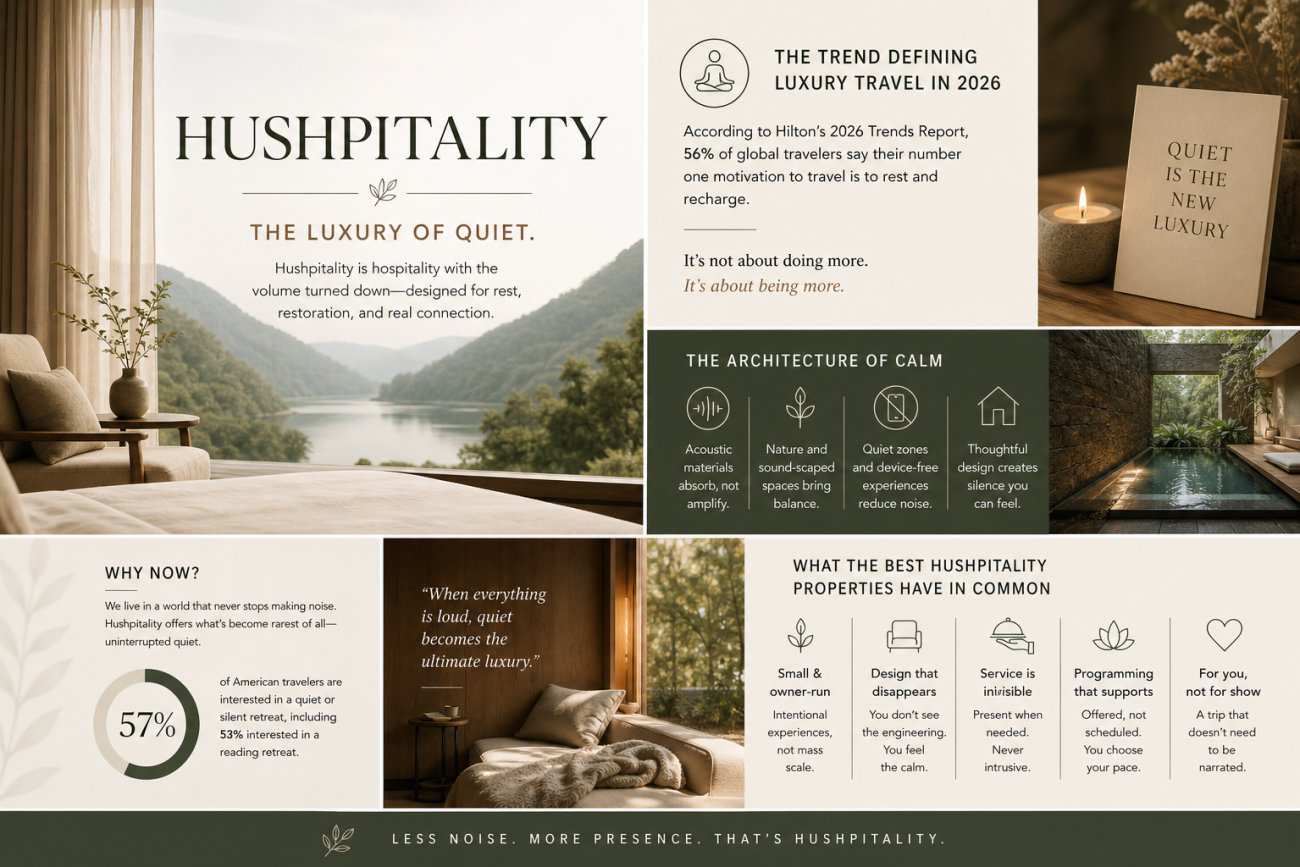
The Architecture of Calm
What separates hushpitality from simply having a quiet room is intention. The best expressions of this trend are not designed around the absence of amenities — they are designed around a specific, considered relationship to sensory experience.
Hotels and retreats are experimenting with acoustic materials, noise-reducing layouts, sound-scaped gardens, and quiet zones where mobile phone use is limited or discouraged. These spaces are intentionally crafted to promote silence without being austere, balancing comfort with tranquility.
Acoustic architecture — the deliberate use of materials, room geometry, and spatial planning to shape the sound experience — is the technical underpinning of all of this. Sound-absorbing panels, natural materials like stone and wood that dampen rather than amplify, rooms oriented away from noise sources, gardens designed with water features that mask ambient sound rather than add to it. None of this is visible. All of it is felt.
The most sophisticated properties go further. Some are engineering what they call “Sound Sanctuaries” with noise-absorbing volcanic stone, and “Dead-Zone” cabins with zero Wi-Fi or cellular signal. Brands like Unplugged in the UK and Six Senses Vana in India now offer rooms where devices are collected upon arrival or stored in signal-blocking lockboxes.
This is not an extreme position. 57% of American travelers surveyed said they would be interested in attending a quiet or silent retreat, including 53% who expressed interest in a reading retreat specifically. The market is enormous, and it is largely unserved by traditional luxury hospitality.
Why This Is Happening Now
The world has become measurably louder in the last decade. Urban density, open-plan everything, the unrelenting acoustic texture of notification culture — our nervous systems are absorbing more stimulus than at any previous point in modern life. The desire to escape that isn’t weakness or introversion. It is a physiological response to genuine overstimulation.
Wealthy travelers, specifically, are exhausted and overstimulated, and willing to pay handsomely for relief. The fastest-growing segment of luxury travelers now pays a premium for less: less noise, less stimulation, less congestion.
The framing of luxury has always tracked with scarcity. When everything is abundant, what becomes rare is what becomes desirable. Right now, the rarest thing in most people’s lives is uninterrupted quiet.
What the Best Hushpitality Properties Share
Having thought about what distinguishes the most compelling expressions of this trend, a few qualities recur.
They are small and owner-run. The hushpitality sensibility does not scale easily. The properties leading this shift tend to attract guests who are self-selecting — people who genuinely want to be present rather than people who have come to be seen. That self-selection is part of what makes the experience work.
The design does the work quietly. In the best rooms, you do not notice the acoustic engineering until you realize that you have been exhaling for ten minutes. This is the mark of design that has been fully absorbed into experience.
Service is present but invisible. The hushpitality approach to hospitality is the opposite of the grand arrival performance — no theater, no fanfare, no intrusion. Staff appear when needed and vanish when not. The guest is never made aware of the machinery.
Programming complements rather than fills. Guided meditation, nature walks, sleep rituals, reading time — these are offered, not scheduled. The hushpitality property trusts its guests to know what they need and creates the conditions for it.
What This Means for How We Think About Travel
There is a more personal dimension to all of this that I want to name directly.
The travel we have been sold for the last decade has been largely performative. The curated grid, the arrival shot, the constant documentation of experience. None of that is wrong exactly — but it creates a particular kind of exhaustion that is hard to recover from because the recovery itself becomes another thing to perform.
Hushpitality offers a different proposition entirely: the trip that doesn’t need to be narrated. The stay that exists for you and no one else. The room you never photograph because the quality of your presence in it is the entire point.
The properties leading this shift attract guests who actually want to be present rather than people who have come to be seen. That distinction — presence over performance — is what makes this trend feel genuinely different from the wellness retreat categories that preceded it.
The sound of luxury in 2026 is, increasingly, silence.
There is a particular quality of quiet that only certain spaces possess. Not the absence of sound exactly — but a deliberate, designed calm that you feel in the body before you can articulate it. The kind you encounter in a room where the acoustics have been considered, where the walls absorb rather than reflect, where you become aware, sometimes for the first time in days, of your own breathing.
We have a name for this now. The hospitality industry is calling it hushpitality, and it is the defining luxury travel concept of 2026.
A note on sourcing: This piece is research-based rather than firsthand — I have not personally stayed at a hushpitality property. All editorial perspective is my own, drawn from industry reporting, traveler research, and a genuine belief that this shift in how we think about rest is worth paying attention to.