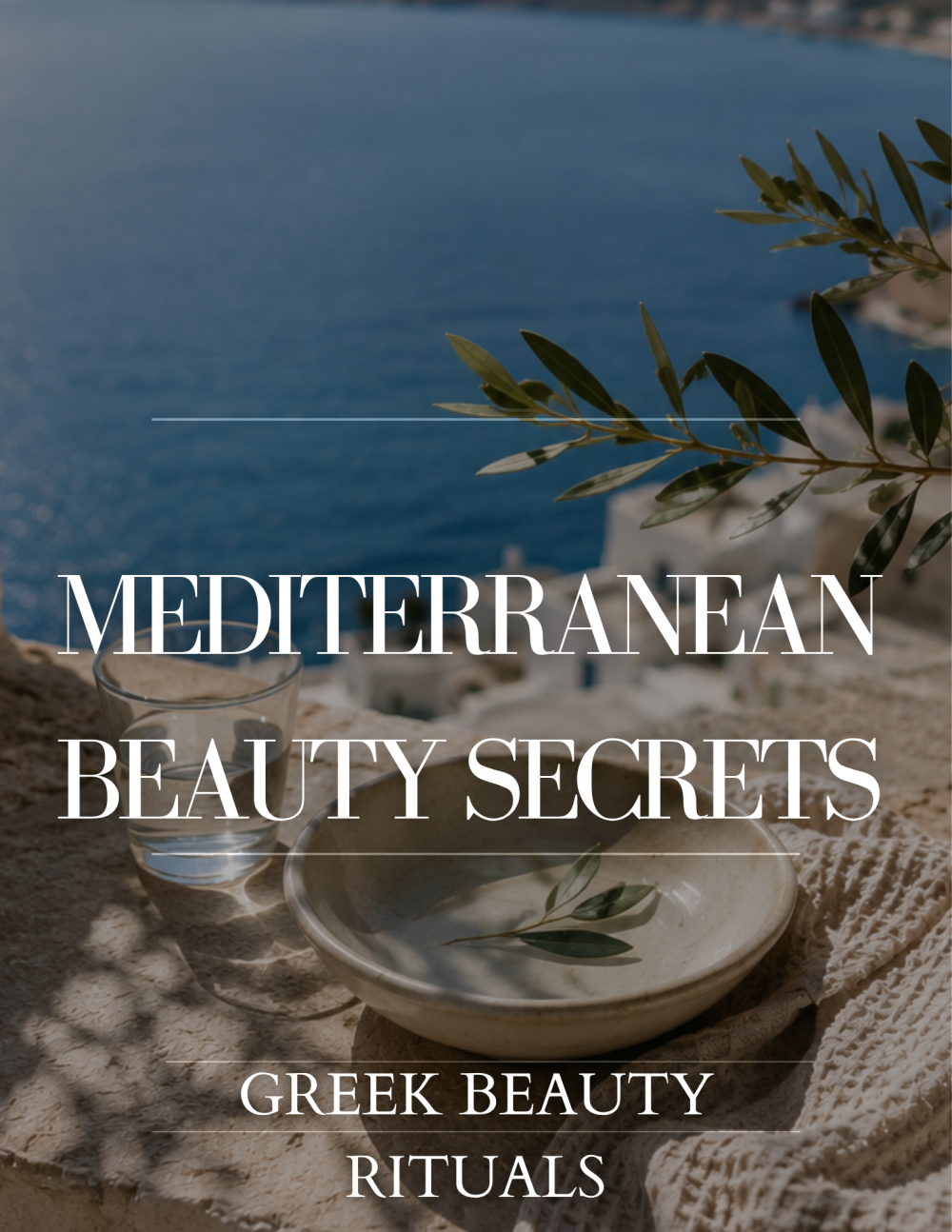
The word “cosmetic” comes from the Greek word kosmetikos — meaning a sense of harmony, order, and tranquility. Not enhancement. Not correction. Harmony.
That etymology has always stayed with me. It suggests that the Greeks weren’t approaching beauty as something to be fixed or performed. They were approaching it as a state of being — something cultivated slowly, from the inside out, with ingredients pulled directly from the landscape around them.
I grew up with fragments of this. The olive oil that appeared in everything. The honey you kept on the kitchen shelf that somehow also ended up on skin. The yogurt that is as much a morning ritual as it is breakfast.
What Greeks did, it turns out, was practice one of the most sophisticated and enduring skincare philosophies in human history. Today, many of these same rituals are reappearing through trends like oil cleansing, skin barrier repair, fermented skincare, botanical actives, and “slow beauty” — often repackaged by the modern beauty industry as something new.
Olive Oil: The Original Everything
Homer called olive oil “liquid gold.” Ancient women of Crete used it for their hair, face, and body as a natural source of vitamins, antioxidants, and amino acids. It was cleanser, moisturizer, sunscreen, hair treatment, and bath ritual — often all in the same day.
Ancient Greeks believed in gentle, nourishing cleansing rather than stripping the skin. They used olive oil to remove dirt, makeup, and impurities while keeping the skin hydrated. This is, almost word for word, the philosophy behind the oil cleansing method that the modern beauty industry has been rediscovering and repackaging for the last decade.
The difference is that Greek women weren’t following a trend. They were following the land.
How to use it now: A small amount of high-quality extra virgin olive oil — cold-pressed, Greek if you can find it — massaged into dry skin and removed with a warm damp cloth. It removes everything without stripping. Your skin will feel different immediately.

Honey: The Mask Your Grandmother Knew
Rich in natural enzymes, antioxidants, and humectants, honey provided ancient Greek women with a versatile tool for skincare. Ancient Greek women enjoyed honey and milk baths as part of their nightly beauty regime.
The ritual was simple: warm honey applied to the face, left for ten minutes, rinsed. What it delivers is antibacterial action, moisture retention, and a brightness that no serum has quite replicated for me personally — though I am admittedly biased.
Apply honey as a 10-minute mask before cleansing. Raw Greek thyme honey specifically — available at any Greek market — has a more complex enzymatic profile than commercial honey and a scent that makes the whole ritual feel like something worth doing rather than something to get through.
How to use it now: Apply a thin layer of raw honey to clean, damp skin. Leave for 10 to 15 minutes. Rinse with warm water. Do this once a week and you may find yourself reaching for brightening serums far less often.
Greek Yogurt: The Anti-Aging Treatment That Costs Almost Nothing
This one surprises people. Greek women used honey, yogurt, and olive oil as masks to lock in moisture. The yogurt component in particular has a scientific basis that ancient Greek women couldn’t have articulated but clearly understood intuitively: the lactic acid in yogurt is a gentle chemical exfoliant that dissolves dead skin cells, the probiotics support the skin microbiome, and the fat content provides immediate moisture.
Full-fat Greek yogurt applied to the face for fifteen minutes is essentially a lactic acid treatment with none of the irritation. For anyone with sensitive skin who has found retinol or AHAs too aggressive, this is worth trying.
How to use it now: Full-fat Greek yogurt, applied as a mask for 15 minutes, once or twice a week. You can add a teaspoon of honey for added brightening, or a few drops of olive oil for extra nourishment. The combination of all three is what Greek women have been calling a face mask since antiquity.
Chios Mastic: The Ingredient the Beauty Industry Is Just Discovering
This is the one that most people outside Greece don’t know, and the one I find most extraordinary.
Chios mastiha is a Protected Designation of Origin product recognized by the European Union — a resin that drips from the bark of the mastic tree found only in the southern villages of Chios. From July to October, villagers carefully score tree bark, allowing translucent “tears” to flow and crystallize — a tradition preserved in essence for over a thousand years.
Dioscorides, writing in the first century AD, reported Greek women using the resin in face creams for skin radiance, and noted that mastic oil “cleanses the face and gives it the color of health.”
Modern science has since confirmed what those women already knew. Recent studies show Chios mastic contains unique triterpenic acids that inhibit collagenase and elastase activity — the enzymes that break down collagen and elastin in the skin. Research confirms that mastiha helps reduce skin irritation and redness, improve skin elasticity, and protect against oxidative stress.
Clarins uses it. Luxury Greek skincare brands like Anthésté have built entire lines around it. And yet most people in the beauty industry still haven’t heard of it — which means you’re ahead of a trend that is genuinely coming.
Where to find it: Greek specialty stores, online Greek markets, or directly through Greek skincare brands like Korres, which has incorporated mastic into several of their formulations. Look for serums or creams that list Pistacia lentiscus in the ingredients.

Sea Salt and the Mediterranean Ritual of Exfoliation
Sea salt mixed with olive oil was used as a body exfoliant in ancient Greece. Natural sea sponges from the Mediterranean — particularly from the Aegean — were used for cleansing and exfoliation.
The Aegean sea sponge specifically has a texture that is both effective and gentle in a way that synthetic exfoliants aren’t, and the tradition of using them goes back far enough that Homer references them in the Odyssey. They are still harvested by hand by Greek divers off the coast of Kalymnos and sold throughout the country.
How to use it now: Combine a tablespoon of fine sea salt with two tablespoons of olive oil. Massage gently onto damp skin in circular motions, rinse thoroughly. This is a body treatment — keep it away from the face, where the salt can be too abrasive. The skin that emerges is soft in a way that makes you understand why Greek women were doing this for thousands of years.
Herbs, Flowers, and the Ritual of Herbal Water
Roses, chamomile, lavender, marigolds, and cypress oil were among the herbs and flowers ancient Greeks incorporated into their beauty rituals. Chamomile specifically — steeped and cooled — was used as a toner and facial rinse for its anti-inflammatory and brightening properties.
This is still practiced in Greek households, though it rarely gets called a “beauty ritual” — it’s just what you do with the chamomile from the garden.
How to use it now: Steep two chamomile tea bags in boiling water, allow to cool completely, pour into a clean spray bottle. Use as a toner after cleansing or as a refreshing facial mist throughout the day. It stores in the refrigerator for up to a week, and the cool mist has an immediate calming effect on inflamed or tired skin.

What All of This Has in Common
Every one of these rituals shares the same foundation: ingredients from the land, used with patience, without the expectation of overnight results. No ten-step routines. No active-ingredient stacking. No monthly subscription boxes.
The Greek approach to beauty was — and in many households still is — an extension of the same philosophy that governed the table. Seasonal. Local. Unhurried. The same olive oil that went into the food went onto the skin. The same honey. The same herbs.
There’s a reason Greek women have been celebrated for glowing skin across centuries of recorded history. And it wasn’t a serum. It was a relationship with ingredients that their landscape provided and their grandmothers understood.
The beauty industry is circling back to all of this now — in the form of oil cleansing, fermented skincare, botanical actives, slow beauty, and the general turn away from clinical toward sensorial. But Greek women were never waiting for the industry to catch up.
They already knew.
Have a Greek beauty ritual passed down in your family that I haven’t mentioned? I’d love to hear it — find me on Instagram @angelica_e