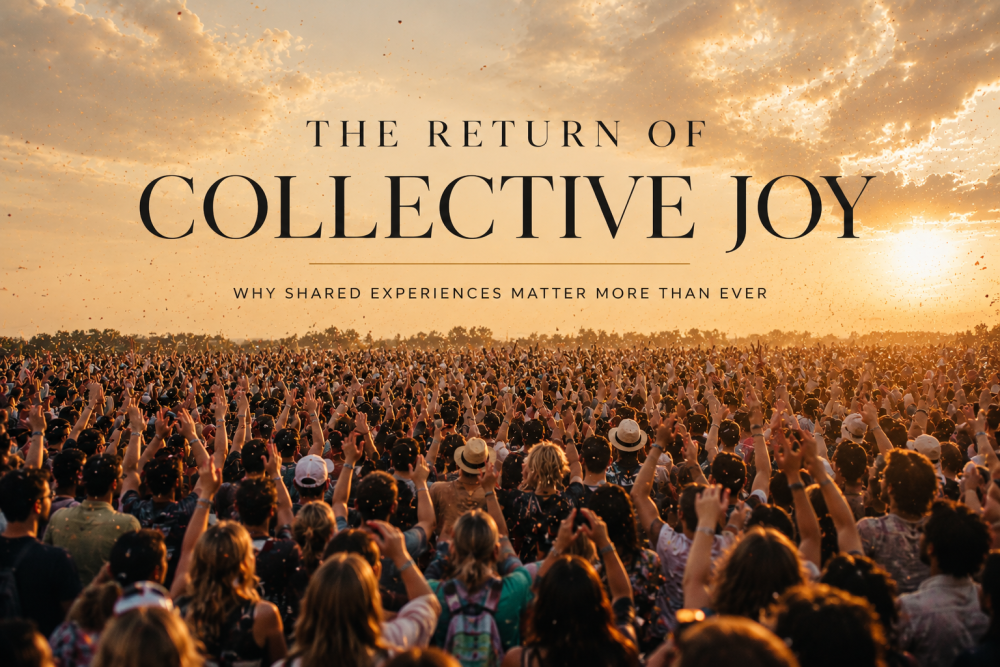
Somewhere between the fourth quarter at Madison Square Garden and the anthem in a stranger’s language at a World Cup match in Toronto, it became clear that June wasn’t a month of events. It was a month of proof — that people still want to stand in a crowd and feel something at the same time as everyone around them.
Over the course of June, I found myself booking flights not because they made logistical sense, but because they felt necessary. One night in Toronto for ninety minutes of football. A 5AM wakeup for a parade. These weren’t efficient decisions. They were human ones. Standing among thousands of people wearing the same red-and-white checks, or the same blue and orange, I realized the trip had never really been about the match.

For a while, that instinct wasn’t obvious. The last few years trained us toward the opposite: watch alone, scroll alone, curate a life that fits neatly into a feed without ever requiring another body in the room. Convenience won, for a long time. Solitude got rebranded as self-care, and there was truth in that — but there was also a quiet cost nobody quite named.
June named it. And it isn’t only happening in stadiums. It’s in concerts selling out within minutes worldwide, marathon fields growing every year, food festivals and street fairs drawing crowds that used to stay home, hotels built entirely around a single weekend event, destination weddings, F1 race weeks, pilgrimage travel booked years in advance. Different rituals, same appetite: people organizing their calendars, their savings, their flights around being somewhere in person, at the same time as everyone else.

The Knicks’ championship run didn’t stay inside the Garden. It spilled into the streets, into bars that didn’t have room for one more person and let people in anyway, into a parade where strangers who had nothing in common except a shared allegiance stood shoulder to shoulder for hours. The World Cup did the same thing on a larger scale — stadiums in Toronto and Philadelphia filled with people who’d flown in from elsewhere, worn colors that meant something personal, and stood next to people whose language they didn’t speak, united by nothing but the same ninety minutes.
There’s a reason the moments that defined June weren’t the ones that photographed best alone. A parade is not a parade with one person on the sidewalk. A stadium chant doesn’t work as a solo. The value wasn’t in the moment itself — it was in how many people were having it at the same time you were.

June was Knicks and World Cup and parades on the surface. Underneath, it was a referendum on how we want to live. After years of optimizing for convenience, the greatest luxury may simply be showing up.
Not a getaway, but a gathering.
Tonight, I’m headed back to Toronto — this time for Croatia’s Round of 32 against Portugal. Check back Friday for that one.
More on where culture is heading — subscribe to The Experiencer Edit and follow @angelica_e on Instagram for real time updates