For the better part of four years, Hollywood’s most prestigious red carpet had an identity crisis. The minimalist era — all clean columns, barely-there satin, the studied nonchalance of not trying too hard — had officially taken over. Quiet luxury wasn’t just a TikTok trend. It colonized the Oscars. Women arrived in sleek slips and muted neutrals, looking beautiful but forgettable, as if the directive had been: dress for the critical profile piece, not the moment.
Sunday night at the 98th Academy Awards was a different story.
The carpet was loud. Intentionally, unapologetically loud — and fashion is better for it.
The Return of Drama
The overarching silhouette was big-skirted and unapologetically romantic — the entire carpet seemed to RSVP “princess core, but make it couture.” Full ball gowns swept past slim, lingerie-adjacent slips, while feathers floated by in every direction. This wasn’t a coincidence or a stylist trend cycle blip. This was a collective exhale. After years of the fashion world telling women that restraint was sophistication, the Oscars pushed back — and the result was one of the most visually compelling red carpets in recent memory.
What the minimalist era got right was editing. What it got wrong was confusing reduction with elegance. There’s a difference between a gown that says I know exactly who I am and a gown that says I was afraid to commit. For too long, the Oscars defaulted to the latter. On Sunday, commitment was back.
The Looks That Signaled the Shift
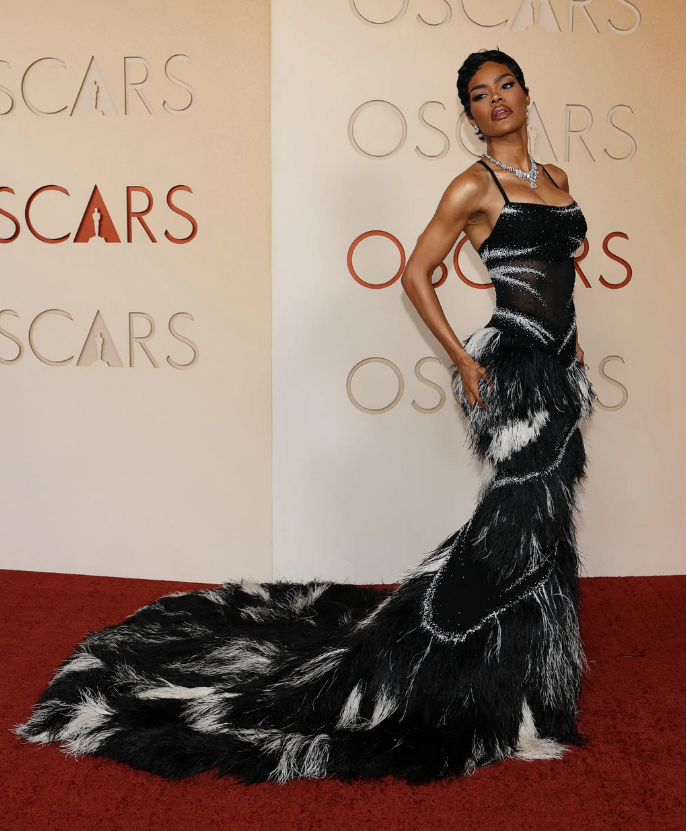
Teyana Taylor in Chanel was the undisputed thesis statement of the evening. The gown featured a sheer spaghetti-strap black bodice embellished with stripes of silver crystals, while tiers of black and white feathers cascaded from her waist down to the tip of a dramatic train. It was showgirl energy filtered through Matthieu Blazy’s new era at the house — classical in structure, audacious in execution. Taylor, who has spent this entire awards season building one of the most coherent fashion narratives we’ve seen — Schiaparelli at the Globes, Tom Ford at the Grammys, Chanel at every possible opportunity — understood the assignment better than anyone: the carpet is theater. Dress accordingly.
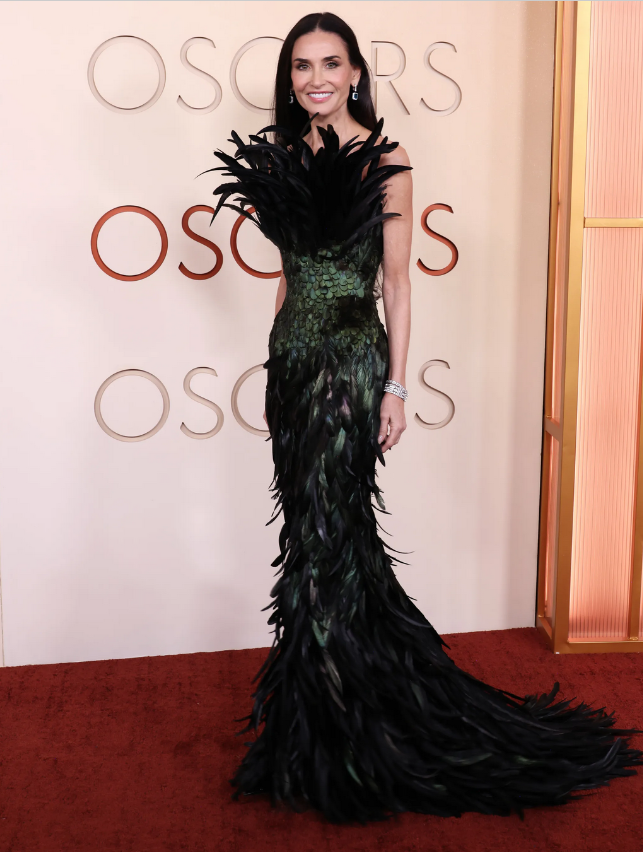
Demi Moore in Gucci arrived with a point to prove. The tufts of feathers turned mossy green around her waist before becoming iridescent atop the mermaid train — her stylist Brad Goreski made clear that Moore wanted to wear something that was “a work of art.” She succeeded. The look evoked peak McQueen-era spectacle — the kind of fashion that stops a room. After years of playing it safe, Moore’s red carpet run this awards season has been a masterclass in dressing with intention.
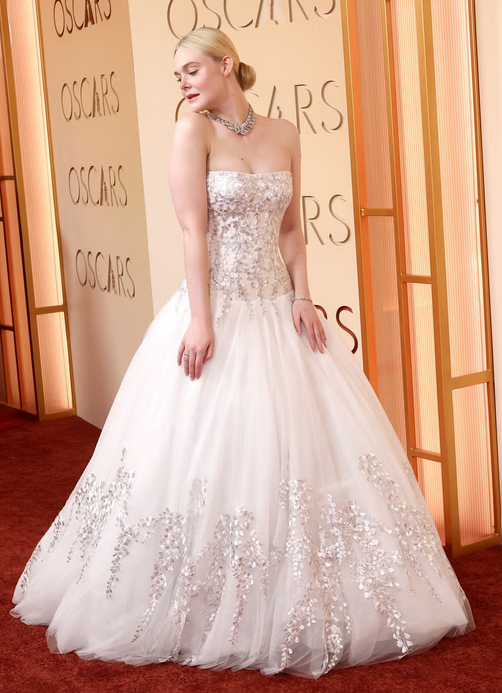
Elle Fanning in Givenchy by Sarah Burton was the fairy tale. A strapless ballgown fitted with hand-stitched lavender-tinted wisteria petals — every single one placed by Burton and her team — paired with a vintage Cartier diamond necklace from 1903. It was the kind of look that reminds you why the Oscars exists as a cultural ritual. Not just cinema — mythology. Fanning understood that. So did Burton, who is quietly building one of the most compelling creative director runs at Givenchy in decades.
Jessie Buckley in Chanel was the wildcard that paid off. An off-the-shoulder gown blocking tomato red against baby pink — a color combination that could have read as confusing but instead landed as a couture valentine. The clean neckline and impeccable fit kept it from tipping into costume territory. Matthieu Blazy keeps proving that he can make the house feel joyful without sacrificing rigor. Two Chanel looks in the top five of any best-dressed list is not a coincidence.
The Fashion Houses That Won the Oscars
The real competition on Sunday wasn’t for Best Picture. It was for carpet real estate — and a few houses dominated.
Givenchy under Sarah Burton had the night. Timothée Chalamet in a custom all-white double-breasted suit with sharp tailoring and white leather boots, Elle Fanning in the wisteria ball gown — Burton positioned Givenchy as the house for people who take fashion seriously but refuse to be boring about it. The Hollywood alliance she’s building is significant: dressing both the Best Actor frontrunner and one of the evening’s most-talked-about women is a strategic coup. Watch this house closely.
Chanel under Matthieu Blazy is in the middle of something special. Teyana Taylor’s Chanel look — fit with black and white feather fringe and silver sparkle stripes — represented exactly why the newly appointed creative director is earning such buzz. Jessie Buckley’s red-and-pink gown added a second iconic moment. Blazy is threading the needle between Chanel’s legacy codes and a genuinely modern point of view, and Hollywood is paying attention.
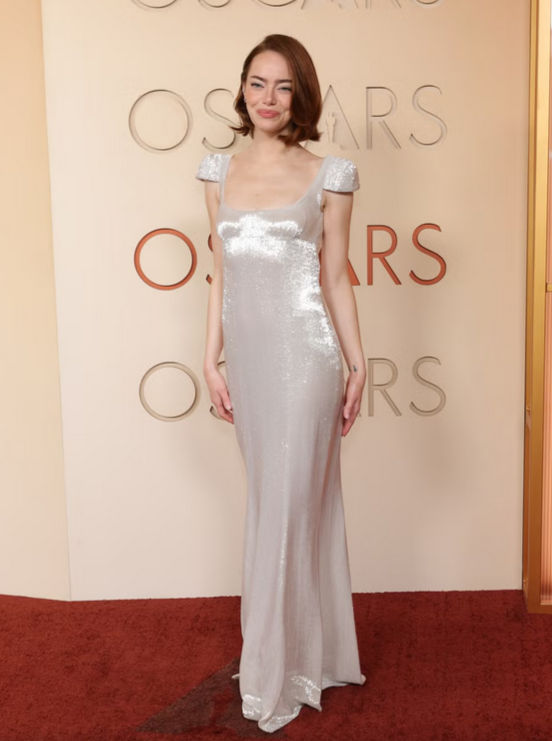
Louis Vuitton played the long game quietly. Emma Stone in a white hand-embroidered sculptural gown, Wunmi Mosaku in a mermaid-green custom gown that framed her nine-months-pregnant silhouette, and Michael B. Jordan in a custom Nehru-style jacket that stripped the tuxedo formula back to its bones. Three very different bodies, three very different moments — all unmistakably LV. That kind of range is a brand-building strategy as much as a styling one.
Gucci made a statement through Demi Moore that the house is back in the conversation for serious red carpet dressing — not just logo culture. The feathered gown was the kind of look that ends up in fashion history books. Brad Goreski’s collaboration with Moore has taken them to Paris and Milan each season to survey the top runways — and it shows. This was not a look assembled from a lookbook. It was a relationship.
What This Means for 2026 Evening Wear
The Oscars don’t just reflect fashion. They instruct it. What happens on that carpet in March echoes through every gala, every benefit dinner, every black-tie occasion for the next twelve months. Here’s what’s coming:
Feathers are back — but with architectural purpose. Not the loose, haphazard plumage of the early 2010s. Structured feather placement, gradient feathering, feathers as a couture material rather than a trim. The distinction matters.
Volume is rehabilitated. The full skirt is no longer a sign that someone didn’t get the minimalist memo. It’s a deliberate choice — and styling has caught up to make it read as modern rather than bridal.
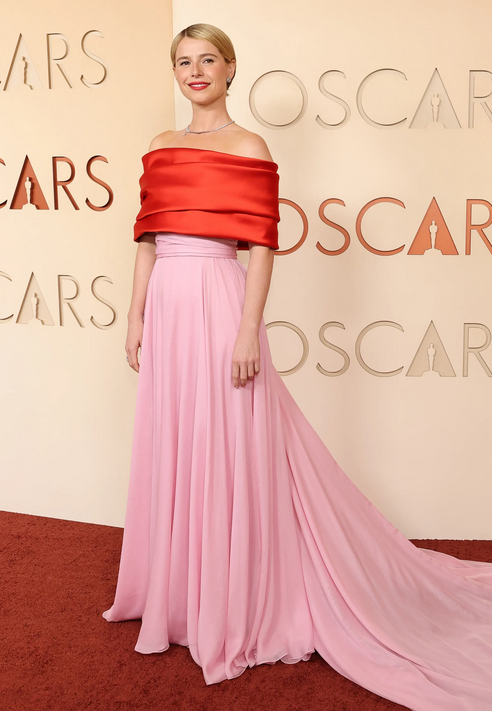
Color blocking is the new neutral dressing. Jessie Buckley’s red-and-pink proved that unexpected color pairings — done with restraint in cut — are more sophisticated than a column of beige ever was.
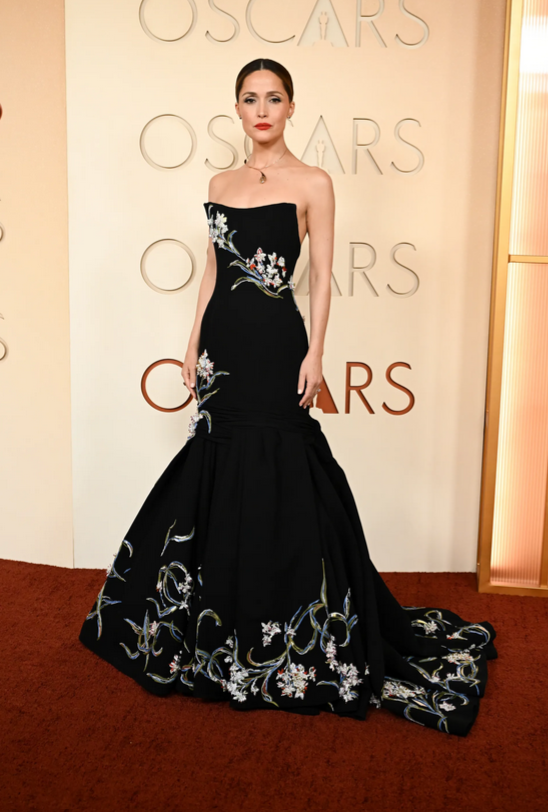
Craftsmanship is the new status signal. Elle Fanning’s hand-sewn wisteria petals, Rose Byrne’s Dior haute couture floral embroidery, Wunmi Mosaku’s hand-embroidered Louis Vuitton — the flex is no longer the logo. It’s the hours. The custom. The collaboration between house and wearer that produces something that couldn’t exist any other way.
And perhaps most significantly: the relationship between a fashion house and a star is the new marketing. Chanel didn’t just dress Teyana Taylor on Sunday — they concluded a season-long narrative that began at the Globes and moved through Grammys, fashion weeks, and every step-and-repeat in between. That is brand positioning at its most sophisticated. It’s also the model luxury houses will be doubling down on as the era of mass celebrity endorsements gives way to something more intimate, more curated, and infinitely more powerful.
The red carpet remembered how to be dramatic on Sunday. Fashion — real fashion, with intention and artistry and something to say — showed up. After years of beautiful restraint, the Oscars finally looked like themselves again.
And honestly? It was about time.